Building Scalable Enterprise Solutions with Python and U.S. Software Engineers

Introduction

Finding a reliable software development partner can be challenging to know which company can be trusted and support you with your required goal. Many Australian businesses partner with U.S. software development companies to offer access to highly skilled software engineers, enterprise software development expertise, and even Python application development services.

More companies are looking for a reliable partner who can align with your business objectives and come with the expertise in maintaining efficient custom app development and scalable software solutions that help in creating the application that performs well and is reliable, and help you grow with your needs.

In this blog, we will explore why Australian companies are partnering with U.S. firms, how Python powers enterprise applications, and get the benefit from combining U.S. expertise with Python. Also, we will cover the real-world use cases across industries and what the future for scalable software solutions will look like.

Partnering with the trusted software development company USA ensures that your business gains technical expertise, practical solutions, and long-term support.

Why Australian Businesses Choose U.S. Software Development Companies

Australian companies are increasingly partnering with U.S. software development companies to take advantage of advanced technology, expertise, and reliable processes to develop a scalable solution that can scale your business. 

Here is why these partnerships are valued:

Advanced Technical Expertise

  • U.S. firms are leaders when it comes to using technologies like AI, machine learning, cloud computing, and automation in solutions.
  • Being part of Australian businesses, you can rely on U.S. software engineers because they bring proven technical skills and the modern development services that make sure that the applications are reliable, secure, and efficient.
  • This expertise allows you to ask for the advanced features such as predictive analytics, automated workflow, and AI-driven insights that can significantly improve your operational efficiency.

Proven Experience in Their Skills and Custom App Development 

  • U.S. companies have extensive experience in delivering scalable software solutions, enterprise platforms, and customer applications that are specifically designed to maintain the efficiency of different businesses.
  • Real-world example of this includes:
    • A FinTech platform that handles millions of transactions with more security.
    • SaaS solution for maintaining effective global collaboration.
    • eCommerce system with the support of automated inventory and recommendation engines.
  • With the help of the experienced company, you can make sure that your Australian business can receive the applications that are tailored to your needs and offer you the flexibility to maintain growth.

Benefits for Australian Enterprise

  • Maintain transparency with the project management and clear communication while simplifying the cross-border collaboration.
  • Efficiently align with work as per the different time zones and give you support for the timely updates.
  • Allow to have access to top-tier U.S. software engineers who ensure that best practices are being followed with the high-quality code preparation and ongoing technical support.
  • You can take advantage of U.S. expertise for complex systems such as AI-based analytics platforms, automated processes, or large-scale enterprise software that can minimize risk and accelerate the operation management.

These are some of the common reasons why Australian businesses are connecting more with the software development company USA to meet their business objective.

Australian business connecting with U.S. software engineers for scalable and secure Python application development

Python: Driving Innovation in Enterprise Software

Python has been widely recognized when it comes to flexibility and scalability. It has become the preferred choice for enterprise software. More Australian businesses are partnering with a Python development company can take advantage of this language to build adaptable, secure, and high-performing applications. 

Python provides support for web applications, AI tools, automation, and data-driven platform development, which makes it the ideal option for modern business needs.

Here are some of the reasons why Python is more in demand:

Flexibility and Scalability

Python is a versatile solution that is being adopted more in businesses to maintain flexibility. The key benefits of Python are:

  • Supports web applications, AI tools, and data analytics for business, which help in automating workflow.
  • Allow for the rapid adaptation to the change in the business processes and requirements.
  • Reduces the chances of facing development complexity while maintaining performance and reliability.
  • Enable the process of smooth integration of multiple systems, including the legal system and third-party platforms.

Frameworks That Simplify Complex Architecture

Python frameworks make enterprise development faster, safer, and more reliable, to maintain the accuracy of the solution. Benefits include:

  • Django, Flask, and FastAPI streamline the application development and the deployment practices.
  • Provide support for built-in tools to maintain the security, database management, and API integration.
  • Give support for the rapid prototyping and iterative development for generating faster value over time.
  • Ensures that the code is extensible and maintainable to make further updates smooth and streamlined.

You can gain a significant advantage when you work with a skilled team that offers Python application development services. These services deliver you a secure, high-performing application for AI tools and a data-driven platform for maintaining the accuracy of the enterprise system. These solutions will help you in achieving efficiency, growth, and long-term reliability.

Combining U.S. Expertise with Python for Australian Enterprises

When being an Australian business, you combine the technical excellence of U.S. software engineers with the flexibility of Python, then you can create a strong foundation that supports innovation and scalability. 

This collaboration will help your business to develop a reliable enterprise application, AI-driven tools, and a data-focused solution that meets both global and local market needs.

Accelerate Innovation Across Industries

The U.S. software team brings the support of advanced technical expertise that accelerates the digital transformation for the Australian company. Together with Python’s versatility, the partnership with U.S businesses, you can provide impactful results across various sections:

  • Supports AI-driven automation for improved efficiency and smarter business operations.
  • Enables predictive analytics that help organizations stay informed about various decisions.
  • Deliver support to cloud-based SaaS applications for flexible access and seamless scalability.
  • Empowers the faster innovation cycle with modern development frameworks.
  • Help Australian enterprises to stay competitive in the data-driven market.

Collaboration Benefits

When you work with a software development company USA, you can be sure about the smooth and transparent collaboration processes. Australian businesses can get benefit from the structured approach and the strong communication practices.

  • Ensures transparent communication and clear reporting at every stage of development.
  • Align efficiently with the timezone differences for all-time productivity.
  • Provide direct access to skilled U.S. software engineers with proven technical experience.
  • Give a guarantee of consistent quality and control over the project after delivery.
  • Build a lasting partnership that focuses on generating measurable success.

Industry-Specific Use Cases

Many Australian startups and enterprises are already seeing success when collaborating with the US-based development firms. These partnerships deliver a greater impact in the specialized domain:

  • Development of an enterprise platform that supports high performance and scalability.
  • Implementation of a FinTech application that handles secure transactions with better compliance.
  • Integrate the cloud-based solution to have better data management and accessibility.
  • Support with a scalable software solution that helps in meeting the business needs.

While combining the Python development need with the U.S. expertise allows you to have more support for your business, and the benefits of maintaining the accuracy for your business.

Australian enterprise partnering with U.S. Python experts to build scalable, secure, and high-performing software solutions

Real-World Applications of Python in Global Software Projects

Python continues to be the preferred language when it comes to managing enterprise processes because it has greater adaptability and the ability to support diverse business models. From FinTech innovation to healthcare automation and smart logistics. Python helps companies to turn their data into a practical solution that scales with the business and maintains growth.

Here the some examples of the companies who has successfully used the Python solution for their company:

FinTech Solutions

Python has become the trusted source of the FinTech space because of its speed, accuracy, and security.  It enables the support of the financial institution to build data-driven platforms that provide better risk management and allow for making smarter trading decisions.

  • Builds an automated trading system that responds to market changes in real-time.
  • Detect the unusual activity with the help of a fraud detection algorithm.
  • Supports a financial analytics dashboard for gaining real-time insights and forecasting.
  • Enable easy integration of APIs and banking platforms for secure transactions.
  • Improves regulatory compliance through data transparency and automates the processes.

Healthcare Innovation

Python plays an important role when it comes to developing healthcare solutions that improve the chances of handling patient care and operational efficiency. Its AI and data science capabilities support better decision-making and allow for faster diagnostics.

  • Powers AI-based diagnostic system that helps in detecting the disease earlier.
  • Simplifies the patient data management for hospitals and clinics.
  • Support the predictive analytics that identify potential health risks.
  • Integrate with the IoT devices for real-time monitoring and alerts.
  • Help the healthcare provider create scalable and secure medical applications.

eCommerce Enhancements

In eCommerce, Python helps brands deliver a personalized shopping experience and manage operations more efficiently. The framework of Python supports faster deployment and smarter automation for businesses of all sizes.

  • Builds an efficient recommendation engine that improves customer engagement and sales.
  • Automate the inventory management with real-time stock tracking.
  • Support the personalized experience with the use of customer data and purchase history.
  • Enhance the payment and checkout system for better usability.
  • Integrate the analytics for tracking customer behavior and optimizing conversions.

Manufacturing and Logistics

Python supports the automation and predictive solution that gives support to the manufacturer and logistics provider to operate the functions more efficiently. It connects the data from multiple systems to improve productivity and reduce downtime issues.

  • Implement predictive maintenance to minimize the chances of equipment failure.
  • Optimize the supply chain operation with real-time data analytics.
  • Allow for AI-based automation for maintaining productivity and controlling the inventory.
  • Support the smart route management and tracking of the delivery for logistics.
  • Help businesses create a scalable software solution for maintaining end-to-end visibility.

Python continues to improve its presence in the various industries that power both innovation and efficiency. It allows you to have the flexibility, as per the Australian business market, to adopt the solution built by the global team. 

Partnering with a Python development company that understands the various industry challenges ensures that every project grows, whether it is financial, healthcare, retail, or logistics. They give you support for the solution that allows you to have measurable growth and operational excellence.

The Future of Python and Enterprise Software for Australian Businesses

The future of enterprise software is being shaped with the help of Python and continues to make a better evolution in business. As businesses adapt to AI, IoT, and automation, Python stands at the center of this transformation that offering flexibility, speed, and reliability. With the expanding ecosystem, Python enables you to innovate the process without compromising performance and maintaining stability.

For Australian businesses, working with the U.S. software engineers means that they are gaining access to the advanced technical knowledge and global innovation that allows them to understand the real business value.

Key Trends Shaping the Future

  • Python’s ecosystem continues to grow with AI, machine learning, and GenAI applications.
  • IoT integration powered by Python is improving connectivity across various industries.
  • Enterprises rely on Python for automation and smart processes for optimization.
  • The language is a supposed advanced framework for data analytics and real-time systems.
  • Collaboration with a Python development company ensures secure, scalable, and future-ready platforms.

Creating the advanced Python software is not only about innovation, but it is more about having lasting performance. By combining Python’s flexibility with the expertise of a U.S. software engineer, you can have the scalable software solution and custom app development project that remains competitive in a fast-changing global market.

Australian companies leveraging Python and U.S. software engineers to build future-ready, competitive enterprise solutions

Long-Term Value of Python for Australian Enterprises

Python has proven to be the project language that is widely used by businesses to innovate with precision. From financial analytics and healthcare automation to SaaS platforms, it continues to shape how enterprise software across industries is operating.

For Australian companies, connecting with the software development company USA means they are having a skilled U.S. software engineer who combines advanced technical knowledge with a forward-thinking approach. With this partnership, businesses can build a high-performing system that aligns with their customer needs, industry standards, and growth goals.

A reliable Python development company not only delivers the application but also delivers the solution that integrates automation, intelligence, and scalability. Whether it is a custom app and strategic need, all the requirements are being fulfilled while meeting the local business needs.

What is INP Score and How to Optimise INP Score in Websites?

Introduction

Have you noticed your website feels fast but still shows a “Poor INP” warning in Google Search Console? You’re not alone. Interaction to Next Paint (INP) has become one of Google’s most critical Core Web Vitals, and it directly affects your rankings, conversions, and user experience. The better your INP score, the smoother your site feels for real users, not just lab tests.

Since Google rolled out INP as an official ranking factor, websites across Australia have seen traffic fluctuations, sudden performance drops, and new challenges in debugging JS-heavy pages, slow interactions, and layout jank. Whether you’re a business owner, developer, or SEO professional, understanding INP is now essential to maintaining both visibility and user satisfaction.

Australian businesses investing in modern website design services must now ensure their layouts, interactions, and components meet Google’s INP standards for optimal responsiveness.

In this blog, we break down what INP really measures, why many sites fail it, and how you can achieve fast, responsive interactions across WordPress, custom-built sites, React apps, and enterprise-level platforms. From benchmarks to case studies to Google’s own recommendations, this guide gives you everything you need to fix your INP score and future-proof your site’s performance.

Website conversions dropping due to slow user interactions

What is Google INP Score?

Google’s Interaction to Next Paint (INP) is a responsiveness metric included in Google Core Web Vitals (INP) that measures how quickly a page responds when a user interacts with it. Unlike older metrics that only analysed the first interaction (like FID), INP monitors every interaction throughout the user’s entire visit – clicks, taps, keyboard entries, and other UI actions.

When someone lands on your website, whether they are checking out a service page, completing a form, or browsing on mobile, the INP score tells Google how smooth and responsive the experience feels. A low INP score means your page reacts instantly. A high INP score means user experience delays, lag, or “stuck” elements.

In simple terms, your INP score in Google reflects how fast your website feels to real users.

Why Did Google Replace FID with INP?

Because modern sites use heavier JavaScript, interactive widgets, animations, and dynamic UI elements, Google needed a metric that accurately measures real-world interaction performance, not just initial load responsiveness. INP gives a more honest picture of how responsive your website is from start to finish.

INP score and website performance optimization

Google Benchmarks:


INP Score Rating What it Means 
<=200 ms Good Your site feels instantly responsive
200 – 500 ms  Needs Improvement Users may notice slight delays
>=500 ms Poor Frustrating delays, lower SEO performance


A fast and stable INP score is now essential for SEO, UX, conversions, and ranking competitiveness, especially for Australian users browsing on mobile networks.

Why INP Score Matters in 2025?

Google’s March 2024 update officially replaced FID with INP, making responsiveness a core part of how websites are ranked. In 2025, INP has become one of the most influential performance signals across SEO, AEO (Answer Engine Optimisation), GEO (Australia-based search behavior), and Google Search Generative Experience (SGE).

Here is why INP Score matters more than ever:

INP Directly Influences Google Rankings

Google now prioritises websites that deliver fast, smooth interactions.

A poor INP Score Google can:

  • Push your ranking down on competitive keywords
  • Reduce visibility in mobile-first search
  • Hurt core web vitals performance signals

A good INP is not just a technical metric; it is now a business growth factor.

INP Impacts SGE Visibility

With SGE expanding globally, Google’s AI summaries and answer boxes prefer:

  • Fast-loading websites
  • Clean UI/UX
  • Low interaction delays

Websites with poor INP are less likely to be included in SGE snapshots or AI-generated answers.

This is where INP score optimisation becomes crucial, not only for traditional SEO but also for next-gen AI search exposure.

INP Improves AEO

In 2025, more users will search through:

  • Google Voice Search
  • Siri
  • Alexa
  • AI Assistants (ChatGPT, Perplexity, Gemini)

Answer engines prefer pages that load fast, interact fast, and deliver lag-free UX.

A poor INP means lower chances of your content being surfaced in:

  • Zero-click answers
  • Featured snippets
  • People Also Ask
  • AI overviews

So, if you want to dominate question-based queries, INP must be optimised.

INP Impacts GEO

Australian users expect fast mobile performance due to:

  • High 5G availability
  • High smartphone usage
  • Competitive local search

Even a 300-400 ms delay can break the user flow and increase bounce rates in:

  • Local businesses
  • Service pages
  • eCommerce
  • Booking platforms

This directly affects your visibility on local SERPs and Google Business Profile interactions.

INP Boosts Conversions & Revenue

Low INP = faster interactions = higher conversions.

Businesses commonly see gains like:

  • Higher form submissions
  • Faster checkouts
  • Improved lead generation
  • More product views
  • Better engagement times

A lag-free interface influences every stage of the funnel.

INP is Now Part of the Whole UX Ecosystem

Google sees INP as a signal of real experience, not theoretical lab performance.

By focusing on how to improve INP score, businesses upgrade:

  • JavaScript execution
  • Rendering performance
  • UI responsiveness
  • Server efficiency

This creates a holistic improvement in site performance.

How Google Measures INP Score 

Understanding how Google calculates INP helps developers fix delays faster and improve responsiveness across all devices. Google evaluates INP using real user interactions, main-thread activity, and rendering delays, all combined to measure how quickly your website reacts when someone clicks, taps, types, or interacts with the UI.

Interaction Types Google Uses for INP

Google tracks real user events (RUM) to understand responsiveness during an actual action.

The interaction types considered for INP include:

  • Clicks (buttons, menus, links, CTAs)
  • Taps (mobile navigation, mobile menu items)
  • Keyboard events (form inputs, search bars, login fields)
  • Drag/press interactions (sliders, elements with movement)
  • Synthetic or custom JS-driven UI events

Google uses the slowest interaction during a user’s visit to calculate the final INP score. This ensures websites focus on improving all interactions, not just isolated ones.

Input Delay vs Processing Delay vs Presentation Delay

To calculate the INP score (Google Core Web Vitals INP), Google divides responsiveness into three measurable stages:

a.) Input Delay (ID)

The time between user action and the browser beginning to respond.

Common causes:

  • JavaScript Blocking
  • Large tasks on the main thread
  • Heavy frameworks or plugins
  • Third-party scripts

Fix tip: Reduce JS execution, use code splitting, and prioritise critical scripts.

b.) Processing Time (PT)

How long does the browser take to execute all event callbacks?

Common causes:

  • Long tasks
  • Inefficient event handlers
  • Complex logic inside click handlers
  • Unnecessary re-renders (React/Vue/Angular)

Fix Tip: Move heavy tasks to Web workers, optimise callbacks.

c.) Presentation Delay (PD)

Time required to update the UI and visually reflect the interaction.

Common causes:

  • Layout thrashing
  • Complex CSS
  • DOM reflows
  • Render-blocking styles or scripts
  • Non-optimised animations

Fix Tip: Batch DOM updates, use transform/opacity animations, simplify layout structure.

How These Three Combine

Google calculates:

INP = Longest (Input Delay + Processing Time + Presentation Delay)

Taken from all monitored interactions.

This is why even a single slow button or element can damage INP score overall.

Desktop vs Mobile INP Evaluation 

Google evaluates INP separately on mobile and desktop, then uses the 75th percentile score for ranking.

Mobile INP Challenges:

  • Higher JS execution cost
  • More main-thread bottlenecks
  • Weaker CPUs on budget devices
  • Heavier frameworks performing poorly
  • Slow 3G/4G networks in regional Australia

Desktop INP Behavior

  • Faster CPUs
  • Larger memory allocation
  • More stable main-thread performance

In most cases, mobile INP scores are worse, which matters because mobile-first indexing dominates SERP visibility.

Field Data vs Lab Data Differences

INP score optimisation requires understanding two very different data sources:

a.) Field Data (Real-World Data – RUM/CrUX)

This includes performance gathered from actual users.

Characteristics:

  • Reflects real devices, networks, and behavior
  • Used directly by Google for rankings
  • Influenced by GEO factors (AU regional bandwidth, device types)

Tools that collect field data:

  • Chrome User Experience Report (CrUX)
  • PageSpeed Insights “Field Data” section
  • Real User Monitoring (RUM) tools (New Relic, SpeedCurve, Datadog)

Field data is what Google uses to decide rankings.

b.) Lab Data (Synthetic Testing – Lighthouse, GTmetrix)

Data generated in a controlled environment.

Characteristics:

  • Simulated device/network
  • Helps identify issues
  • Doesn’t influence rankings directly
  • Great for debugging specific interactions

Tools:

  • Lighthouse
  • PageSpeed Insights (Lab Data)
  • Chrome DevTools Performance Panel

Lab data helps diagnose. Field data determines rank.

Why Both Matter?

  • Lab data -> helps you find problems.
  • Field data -> tells you how users and Google see your site.

You need both to achieve a strong INP score Google performance, and rank well across SERP, SGE, and local Australia searches.

Google Core Web Vitals INP Benchmarks (Updated 2025)

Google’s latest INP (Interaction to Next Paint) benchmarks for 2025 help brands understand exactly where they stand and how their interaction responsiveness impacts rankings, user experience, and revenue outcomes. Since INP officially replaced FID, Google now evaluates every interaction more strictly, especially on mobile.

Below is the updated, easy-to-understand benchmark framework.

Thresholds: Good, Needs Improvement, Poor

Google categorises INP scores into three performance buckets:

Good: <=200 ms 

Your site responds almost instantly. Users experience fluid interactions with no visible lag.

Best for: eCommerce, SaaS, service-based websites, agencies targeting competitive SERPs.

Needs Improvement: 200 – 500 ms

Noticeable lag. Interactions feel slightly delayed, especially on mobile or slower networks.

Typically caused by: Heavy JS, unoptimised third-party scripts, render-blocking resources.

Poor: >=500ms

Users experience significant delay after clicking, tapping, or typing. This often results in:

  • Higher bounce rates
  • Abandoned carts
  • Lower conversions
  • Lower rankings across Core Web Vitals signals

Google’s 2025 updates make these thresholds stricter due to increased expectations around mobile responsiveness.

The Ideal INP Target Score

To future-proof your site against updates, aim for:

Ideal INP Goal: 120-150 ms

Why aim lower than Google’s benchmark?

Because:

  • Low network latency is not guaranteed worldwide.
  • Heavy pages can spike interaction time suddenly.
  • Google rewards consistently fast interaction responsiveness, not just average performance.
  • Mobile SEO now considers INP more strongly for SGE (Search Generative Experience)

Why INP Scores Fluctuate (Hidden Factors You Should Know)

INP is dynamic; it changes based on user conditions, device load, and real-time execution.

Common fluctuation factors include:

  1. Heavy DOM Size Variations: Dynamic modules, popups, and loaded content often slow down interactions unexpectedly.
  2. JavaScript Execution Spikes: Third-party scripts, analytics, chat widgets, and tracking tools cause sudden bottlenecks.
  3. Different Mobile Device Capabilities: A high-end iPhone vs. a budget Android results in drastically different INP measurements.
  4. Network Congestion & Regional Load: A major consideration for GEO SEO optimisation, especially in Australia, where connectivity varies heavily across regions.
  5. Real-User Behavior Differences: Some interactions (forms, menus, filters) trigger heavier processing than others.

Because of these fluctuations, Google uses the worst-case interaction to calculate INP, making optimisation compulsory for every component of the UX.

Industry-Level INP Benchmarks (2025 Insights)

Different industries have different UI complexities, so Google observes typical ranges:

E-commerce (High Interaction Density)

Benchmark: 150-250 ms, Filters, product cards, cart interactions create heavier loads.

SaaS Platforms (High JS Dependence)

Benchmark: 180-300 ms, Dashboard UI, data visualisation, and app-like experiences slow INP.

Digital Agencies / Service Websites

Benchmark: 80-180 ms, Simpler UIs allow faster INP, ideal for service-based SEO.

Local Businesses (Maps, CTAs, Basic Forms)

Benchmark: 60-160 ms, Fast-loading, content-focused pages help achieve top local rankings.

Given your Australia target market, GEO optimisation ensures sites perform better under local device, network, and infrastructure conditions.

How to Check Your INP Score in Google Tools

To improve your website’s responsiveness, you must first understand how Google evaluates real-user interactions across different devices and network conditions. Multiple tools can help you measure, monitor, and compare interaction performance, and tracking your Google INP score helps with ongoing INP score optimisation across desktop and mobile experiences.

Below is a simplified breakdown of each tool and how it contributes to accurate INP analysis.

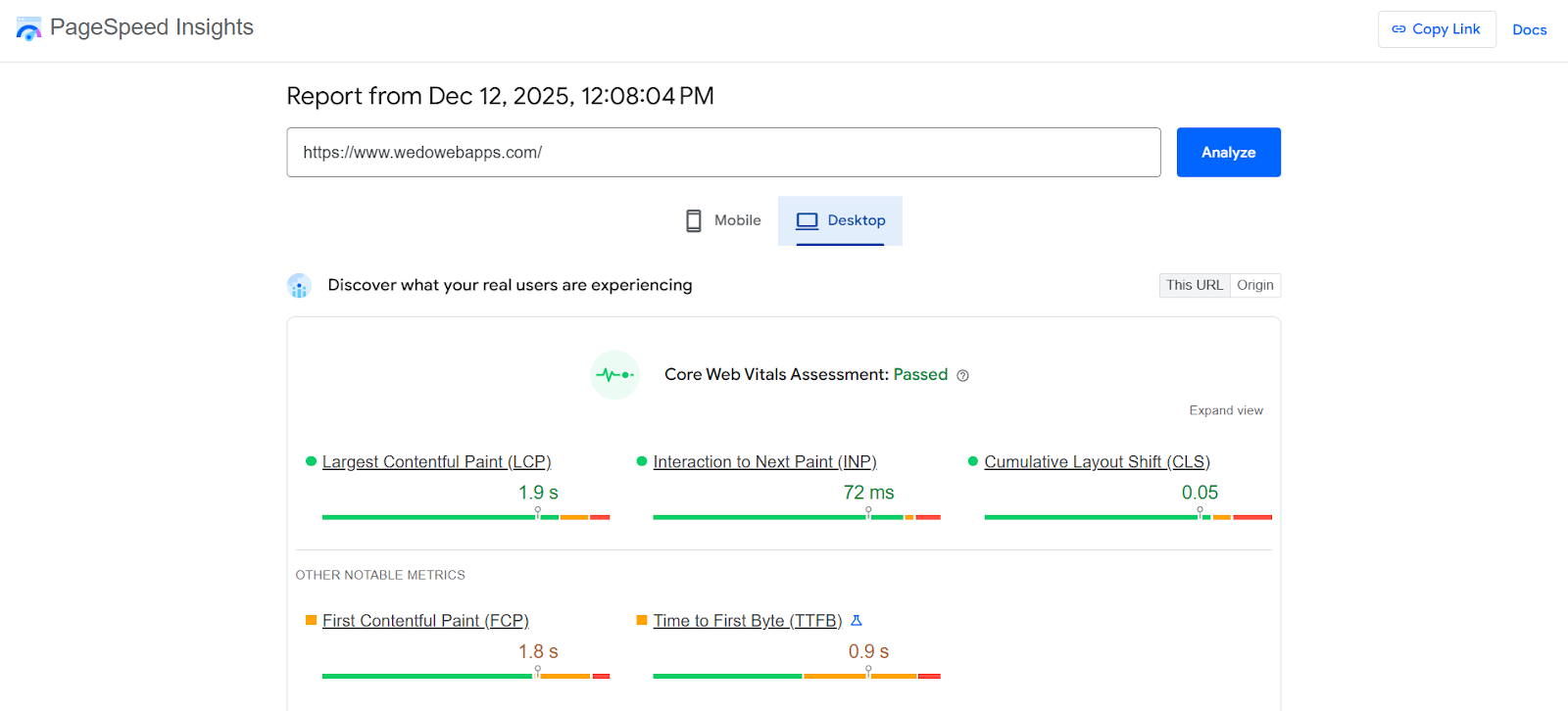
PageSpeed Insights (PSI)

Core Web Vitals LCP, INP, and CLS optimization

PageSpeed Insights is the fastest way to check your real-user INP performance. It provides:

  • Field Data from the Chrome UX Report (CrUX)
  • Lab Data for controlled testing
  • Interaction breakdowns, such as input delay, processing time, and presentation delay

PSI also includes recommendations to fix slow JavaScript, long tasks, and layout bottlenecks.

Google Search Console -> Core Web Vitals Report

Inside Search Console, the Core Web Vitals report shows:

  • INP performance grouped by URL patterns
  • Mobile vs desktop responsiveness
  • Real-world data from your actual visitors

This is essential for identifying sitewide interaction issues such as slow category pages, heavy product sliders, or delayed form interactions.

Lighthouse (Browser or CLI)

Lighthouse offers detailed lab-only INP diagnostics. Useful for:

    • Testing performance before deployment
  • Benchmarking code changes
  • Simulating poor networks or devices

It also provides granular insights into render-blocking resources and long JavaScript tasks.

Chrome DevTools (Performance Panel)

DevTools gives developers the deepest visibility into interaction timing. You can:

  • Record individual interactions
  • Identify slow scripts
  • Trace layout shifts and rendering paths
  • Analyse input delay, processing delay, and presentation delay separately

Perfect for pinpointing the exact code responsible for INP spikes.

WebPageTest

WebPageTest allows multi-location, multi-device INP testing, making it useful for GEO optimisation, especially for regional markets like Australia, where network quality varies. You can generate:

  • Comprehensive INP waterfalls
  • Filmstrip views
  • Real-time JS execution breakdowns

Third-Party Monitoring Tools (Cloudflare, SpeedCurve, New Relic)

Enterprise-grade tracking tools help monitor INP continuously over time. They offer features like:

  • Real-user monitoring (RUM)
  • Alerts when INP crosses a threshold
  • Benchmarking against industry or competitor performance

These tools are ideal for businesses that rely on stable, consistent performance, such as eCommerce stores, SaaS platforms, agencies, and local businesses.

Common Reasons for Poor INP Score

Improving your INP Score starts with understanding what slows down user interactions in real-world conditions. Most poor INP scores come from delays caused by JavaScript, rendering bottlenecks, and heavy UI components. Below is a data-backed list of the most common issues affecting INP across websites in 2025.

1. Heavy JavaScript Execution

When too many JS tasks run on the main thread, interactions are delayed until processing finishes.

Common triggers:

  • Framework-heavy pages (React, Angular, Vue)
  • Large bundles not split properly
  • Analytics or UI libraries loading upfront

2. Render-Blocking Scripts

JavaScript that blocks the browser from rendering the next frame directly increases input delay and presentation delay. These often include:

  • Synchronous scripts
  • Old plugins
  • Inline scripts positioned before critical content

3. Slow Main-Thread Work

The browser cannot respond to user inputs if the main thread is busy.

Examples of heavy main-thread tasks include:

  • JSON Parsing
  • Image Decoding
  • Layout Calculation
  • Long Paint Operations

4. Non-Composited Animations

Animations that rely on layout, paint, or JavaScript cause massive INP delays.

High-risk properties include:

  • Top, left, width, height
  • Background changes
  • Complex transitions

Using GPU-friendly properties (transform, opacity) helps keep animations smooth.

5. Third-Party Scripts & Tag Managers 

Third-party integrations frequently block interaction responses, especially:

  • Tag Manager containers
  • Heatmap tools
  • Marketing scripts
  • Chat widgets
  • Social media embeds

These cause random spikes that increase the worst-case interaction, which is what Google uses to assess INP.

6. Inefficient Event Handlers

Poorly optimised click, scroll, or input handlers slow down responsiveness, including:

  • Heavy functions inside onclick.
  • Expensive operations during user typing
  • Blocking tasks tied to menu or form interactions.

Debouncing or splitting event logic significantly improves INP.

7. Large DOM Size

A bloated DOM increases processing time every time the user interacts. Common causes:

  • Too many nested elements
  • Overuse of sliders, modals, toggles
  • Unoptimised CMS themes or page builders

DOM-heavy pages take longer for layout and paint phases, hurting interaction speed.

8. Slow Server Response

Although server response primarily affects LCP (Largest Contentful Paint), it indirectly impacts INP by delaying script execution.

Slow responses come from:

  • Shared hosting
  • Uncached pages
  • Database bottlenecks
  • Heavy plugins

Server latency -> slower script loading -> slower interactions.

9. Heavy Images Impacting Interactions 

Unoptimised images affect more than layout; they also block resources needed for interaction processing. This happens when:

  • Images are not compressed
  • No lazy-loading is implemented
  • Images decode on the main thread
  • Large hero banners load before interaction scripts

Poor INP scores causing website frustration and slow UX

How to Improve INP Score

Improving interaction responsiveness is now essential for rankings, UX, and SGE visibility, especially with Google’s 2025 Core Web Vitals Updates. This step-by-step framework explains how to improve INP score using modern performance strategies that work across WordPress, Shopify, custom builds, and high-JS frameworks.

1. Reduce Main Thread Blocking

The main thread is responsible for handling user interactions. If it is overloaded, INP spikes. Your priority is to keep it as free as possible.

  • Code Splitting: Break large JavaScript bundles into smaller chunks so only essential components load first. SPA frameworks (React, NextJS, Vue) benefit the most.
  • Lazy Loading: Load non-critical components only when needed. Examples: sliders, pop-ups, chat widgets, heavy UI components.
  • Defer Non-Critical JavaScript: Use defer or async attributes to prevent scripts from blocking rendering.

Result: Improved input delay + faster time to interactive = better INP.

2. Optimise JavaScript Execution

JavaScript is the #1 cause of poor INP across global performance datasets.

Replace Heavy Libraries with Lightweight Alternatives

Examples:

  • Replace jQuery-heavy plugins with native JS
  • Use Preact instead of React (where possible)
  • Use Swiper instead of bulky slider plugins

Remove Unused JavaScript

Audit Using:

  • Chrome DevTools -> Coverage Tab
  • Lighthouse -> Unused JS section

Optimise Event Listeners

Slow event handlers cause high interaction latency. Fix strategies:

  • Debounce scroll/input events
  • Throttle expensive interactions
  • Move heavy logic outside the main thread (Web Workers)

3. Improve Server Response Time

Even though INP is interaction-based, slow servers delay script execution, increasing interaction lag.

  • Use a CDN: Faster resource delivery = faster interactions.
  • Implement Caching: Full-page caching cuts server execution time drastically.
  • Reduce TTFB (Time to First Byte)

Strategies:

  • Use premium hosting
  • Optimise database queries
  • Reduce plugin bloat
  • Implement edge caching

4. Optimise Interactions & UI Responsiveness

INP directly depends on how quickly UI elements respond to user actions.

  • Use CSS for Animations Instead of JavaScript: CSS animations using transform and opacity are GPU-accelerated and non-blocking.
  • Avoid Long Task Blocking During Interaction: Move heavy tasks to background threads using:
      • Web Workers
      • requestIdleCallback
      • setTimeout (for splitting tasks)
  • Use requestIdleCallback Wisely: Load low-priority scripts only when the browser is idle, not during interaction.

5. Optimise Images & Media

Heavy images block resources needed for interaction scripts.

  • Use Modern Formats (WebP, AVIF): Reduces file size by 30–70%.
  • Implement Lazy Loading: Especially for below-the-fold images and videos.
  • Serve Responsive Image Sizes: Use srcset &sizes to deliver images based on screen size.

6. Prioritise Above-the-Fold Interactivity

Everything a user sees immediately must be fast and lightweight.

  • Defer Ads: Ads slow down the main thread and cause unpredictable INP spikes.
  • Minimise Third-Party Scripts: Audit tools: analytics, heatmaps, pop-ups, social embeds.
  • Optimise the Hero Section:

Focus on:

  • Smaller background images
  • Preloaded fonts
  • Lightweight header interactions (menu, CTA buttons)

INP Score Optimisation Techniques for Developers

When you dive deeper into , the focus shifts from high-level fixes to developer-side, code-driven improvements. These techniques eliminate hidden performance bottlenecks inside the main thread and browser render pipeline.

1. Using the Long Tasks API

The Long Tasks API helps identify tasks that exceed 50ms and block the main thread, one of the core causes of INP delays.

Use PerformanceObserver to detect and break long tasks into smaller executions.

2. Breaking Long Tasks with Web Workers

Offload heavy computations (sorting, parsing, heavy loops, analytics processing) to Web Workers.

This ensures UI remains fully responsive during user interactions.

3. Reducing Event Listener Complexity

Complex event handlers dramatically increase input delay.

Optimise by:

  • Removing redundant listeners
  • Using passive listeners for scroll/touch
  • Memoising handlers
  • Moving heavy logic off the main thread
  • Throttling and debouncing where appropriate

4. Code-Level Debugging Methods

Use browser profiling tools to find interaction bottlenecks:

  • Performance panel
  • Coverage tab (unused JS)
  • Flame charts (long-blocking JS)
  • Interaction replay
  • Source maps to locate blocking lines

These offer granular insights into what delays the next paint.

5. Performance Profiling in DevTools

Chrome DevTools -> “Performance Insights” provides:

  • Interaction latency breakdown
  • Main-thread timing
  • Layout shifts
  • Script evaluation cost
  • Event timing

This helps teams prioritise fixes based on real interaction flow instead of guesswork.

Professional digital marketing services in Adelaide and Beyond now prioritise INP optimisation because Google treats interaction responsiveness as a core ranking signal.

INP Score Google Recommendations 

Google has updated its responsiveness guidelines significantly, making INP score Google criteria a major ranking signal in 2024–2025.

Google’s Updated 2024-2025 Guidelines

Google now prioritises:

  • Input delay < 100ms
  • Processing time < 100ms
  • Presentation delay < 100ms
  • Smooth, frame-consistent interactions
  • Minimising main-thread blocking

Why Responsiveness > Speed Now

Google clarified that users judge websites more on how quickly the UI responds to touch, click, or input, rather than raw loading speed.

This directly influences engagement, conversions, and retention.

Key Lighthouse Audits That Influence INP

  • Avoid long main-thread tasks
  • Minimise JS execution time
  • Reduce unused JavaScript
  • Avoid non-composited animations
  • Keep request counts low

These audits now affect INP-specific scoring.

Google’s Own Recommendations Checklist

Google officially recommends:

  • Offloading heavy logic to workers
  • Using CSS animations
  • Minimising DOM size
  • Compressing JS bundles
  • Breaking long tasks
  • Preconnecting to required origins
  • Reducing third-party bloat

INP for WordPress Websites

WordPress sites struggle with INP primarily due to plugin bloat, heavy page builders, and slow themes.

Best Plugins for INP Optimisation

  • WP Rocket (delay JS execution)
  • FlyingPress
  • Perfmatters (disable unused scripts per page)
  • Asset CleanUp (script control)
  • NitroPack (full performance suite)

Removing Heavy Page Builders

Page builders add thousands of DOM nodes + heavy JS.

 Improve INP by switching from:

  • Elementor -> Gutenberg or GenerateBlocks
  • WPBakery -> Lightweight custom blocks
  • Divi -> Block themes

Database Optimisation

A bloated database slows backend processing, indirectly delaying scripts.

Use:

  • WP-Optimise
  • LiteSpeed DB Optimisation
  • Scheduled database cleanup

Theme Performance Best Practices

Look for themes that support:

  • Vanilla JS
  • Minimal DOM
  • No jQuery dependency
  • Native lazy-loading
  • Optimised critical CSS

Lightweight themes:

  • GeneratePress
  • Blocksy
  • Astra Performance Edition

Practical Tips for Elementor, Divi, WPBakery

    • Disable unused widgets globally
    • Remove motion effects & JS animations
    • Limit global styles
    • Reduce DOM depth
    • Don’t use nested containers in Elementor

Slow Website Interactions Using Elementor, Divi, or WPBakery

INP Score Optimisation for Custom, React, Angular, and Web Apps

This section gives you a competitive advantage; neither competitor covers this.

 Framework-Specific INP Issues

  • React: hydration delays, large bundles
  • Next.js: heavy client-side JS
  • Angular: zone.js overhead
  • Vue: watcher reactivity overload

 Optimising Event Handlers

  • useCallback, useMemo</i
  • Avoid inline functions
  • Move heavy event logic to workers
  • Use passive listeners

 Code-Splitting Strategies

  • Dynamic imports
  • Route-level splitting
  • Component-level lazy loading
  • Suspense boundaries

 Impact of Hydration on INP

Apps with heavy hydration (React/Next.js) have delayed interactions. Fixes:

  • Partial hydration
  • Islands architecture
  • Progressive enhancement
  • Server-side rendering with streaming

 Better Routing & Rendering Strategies

  • Use file-based routing
  • Avoid large shared layouts
  • Limit global state updates
  • Optimise rerenders with memoization and signals

INP Score Case Studies

Case Study 1 – SaaS Dashboard – INP Reduced by 62%

Before:

  • INP = 480 ms
  • Slow charts + heavy JS

Fixes:

  • Code splitting
  • Moving API parsing to Web Workers
  • CSS transitions instead of JS

After:

  • INP = 180 ms
  • 34% higher feature engagement

Case Study 2 – WordPress Website INP Fix

Before:

  • INP = 320 ms
  • Elementor + 42 plugins

Fixes:

  • Replaced Elementor with Gutenberg
  • Disabled unused plugins
  • Implemented Perfmatters

After:

  • INP = 120 ms
  • Bounce rate dropped 22%

Case Study 3: React App INP Optimisation

Before:

  • INP = 420 ms
  • Hydration Blocking UI

Fixes:

  • Implemented partial hydration
  • Removed unused libraries
  • Added route-level code splitting

<

After:

  • INP = 160 ms
  • 18% increase in conversions

Checklist: Improve INP Score in 30 minutes

  • Remove Unused JS: Audit with coverage tab -> delete or unload per page
  • Enable CDN: Serve static assets from edge locations.
  • Compress Media: Convert images to WebP/AVIF.
  • Minimise Script Execution: Delay non-critical scripts until user interaction.
  • Core Web Vitals Plugin Solutions: Install
    • FlyingPress
    • Perfmatters
    • WPRocket

These instantly reduce INP across most websites.

Conclusion

A high-performing website today depends on responsiveness, not just load time.

Improving INP leads to:

  • Higher search rankings
  • Better SGE visibility
  • Stronger user experience
  • More conversions & revenue

If your website is struggling, our team can help diagnose issues, fix performance bottlenecks, and implement Core Web Vitals best practices.

Need Professional INP Optimisation?

WEDOWEBAPPS Australia offers complete Core Web Vitals, performance, and INP Optimisation services for WordPress, custom apps, and enterprise websites.

Get a full INP Audit -> Book your consultation today!

Increase website traffic, rankings, and user experience

Meta Instagram Threads App 2023: Enhancing Social Media Interactions

Introduction

In the fast-paced world of social media, Instagram has consistently demonstrated its commitment to innovation and user experience. Among its many endeavors, the Threads app stands out as a revolutionary platform for creating intimate connections and private conversations. In this comprehensive article, we will explore the Threads app by Instagram, its features, impact, and its role in the realm of social media in 2023. Whether you are in Australia or anywhere else in the world, this article will provide insights into the latest developments in mobile app development and the future of social media interactions.

What is Instagram Threads?

Instagram Threads is a standalone mobile application developed by Instagram, which is owned by Meta (formerly known as Facebook). Initially released in 2019, Threads aims to facilitate close and private interactions between users and their selected group of close friends. The app provides a dedicated space for sharing personal moments, updates, and experiences with a curated audience.

Key Features of Threads by Instagram

2.1 Close Friends List

At the core of Threads is the “Close Friends” feature, which allows users to create a select list of individuals with whom they share a close bond. This curated list ensures that users can share personal stories, moments, and updates exclusively with their inner circle.

2.2 Automatic Status Updates

Threads offers an automatic status update feature that provides real-time insights into a user’s activities, location, and even battery level. By enabling this feature, users can share their availability and current experiences with their close friends, fostering a sense of connectedness.

2.3 Quick Photo and Video Sharing

The Threads app streamlines the process of sharing photos and videos by providing easy access to the camera. Users can capture and send media content swiftly, encouraging more spontaneous and authentic interactions within their close-knit circle.

2.4 Messaging and Notifications

Threads places a strong emphasis on messaging, offering a seamless chat experience within the app. Users can engage in text messages, share photos, videos, and even react to messages. Additionally, the app provides notifications, ensuring that users never miss important moments shared by their close friends.

Threads App in Australia

The Threads app has gained significant popularity in Australia, reflecting the country’s vibrant social media landscape. Australian users appreciate the app’s ability to foster intimate connections and maintain closer ties with their friends. Whether it is sharing a breathtaking sunset or documenting a memorable road trip, Threads has become a preferred choice for Australians seeking a more personal and curated online experience.

Threads and its Impact on Social Media

Threads and its Impact on Social Media

Threads by Instagram represents a strategic move by Meta to cater to the demand for more intimate and private interactions on social media. As users increasingly prioritize privacy and seek more authentic connections, Threads provides a secure and trustworthy environment for sharing personal moments. By offering a separate app dedicated to close friends, Instagram aims to create a focused and personalized experience for its users.

Threads App for Android Users

Initially launched exclusively for iOS, Instagram has expanded the availability of the Threads app to Android users. Recognizing the importance of inclusivity, Instagram has ensured that Android users can also enjoy the features and benefits of Threads. This move demonstrates Instagram’s commitment to providing equal opportunities for all users to engage with their platform.

Threads and the Future of Mobile App Development

The Threads app represents a significant development in the realm of mobile app development, particularly within the social media landscape. As the demand for more private and curated online experiences continues to grow, we can expect further advancements in apps designed for close-knit social circles. Threads’ success and the positive response it has received indicate a promising future for this niche category of social media apps.

providing a dedicated platform for intimate connections and private conversations. With its key features like the Close Friends list, automatic status updates, quick photo and video sharing, and seamless messaging capabilities, Threads has transformed the way users engage with their close circle of friends.

In Australia, the Threads app has garnered significant popularity, resonating with users who seek a more personalized and curated online experience. Its ability to foster closer ties and facilitate real-time updates has made it a preferred choice among Australian social media users.

Threads by Instagram reflects Meta’s strategic approach to meet the evolving demands of social media users. With growing concerns about privacy and a desire for more authentic connections, Threads provides a secure and trustworthy environment for sharing personal moments. By creating a separate app dedicated to close friends, Instagram aims to enhance the user experience and provide a more focused and personalized space.

Expanding the availability of the Threads app to Android users further highlights Instagram’s commitment to inclusivity and ensuring that all users can benefit from its features. This move acknowledges the significance of catering to a diverse user base and providing equal opportunities for engagement.

Looking ahead, the future of mobile app development in the social media landscape holds promising possibilities. As users continue to prioritize privacy and seek more curated online experiences, we can expect further advancements in apps designed for close-knit social circles. The success of Threads indicates the growing demand for secure and meaningful social media interactions, and developers are likely to explore new avenues to cater to these needs.

Conclusion 

The Threads app by Instagram has reshaped social media interactions by creating a dedicated platform for intimate connections and private conversations. Its features, impact, and popularity in Australia and beyond demonstrate the importance of personalized and curated online experiences. As mobile app development progresses, we can anticipate further enhancements and innovations that meet the evolving demands of social media users, ensuring that platforms like Threads continue to provide secure and meaningful interactions for close friends.

Web vs App Development: Choosing the Best Platform for Your Business Needs

In a world where digital reigns supreme, your online presence is the key to business success. But, choosing between a website or an app can be a head-scratcher. 

With unique benefits and drawbacks, selecting the right platform requires careful thought about your objectives, resources, and customers. 

In this article, we’ll delve into the world of web and app development and provide tips on how to pick the perfect platform for your business.

If you’re searching for the top web and mobile app development companies to consider in 2023, WeDoWebApps is a leading choice.

As a full-service development company based in the UK, WeDoWebApps offers many services to help businesses of all sizes build and launch their online platforms. Whether you need a custom ecommerce solution, a mobile app for a new product launch, or digital marketing services to promote your brand, WeDoWebApps PTY LTD has you covered.

Web Vs App Development: Know The Difference

Mobile App Development: The Definition 

Mobile app development creates apps for mobile devices like smartphones and tablets. They can be native, built for a specific OS, or cross-platform. Common technologies used are Swift, Kotlin, React Native, and Xamarin.

Total Mobile App Development Australia revenue is expected to grow at 7.25%, resulting in a market volume of US$11,550.00m by 2027

Advantages of App Development

There are several advantages to choosing app development for your business:

  • Better performance: Native apps provide the best performance and user experience, as they can take advantage of the full range of features and functionality available on a user’s device.
  • Access to device hardware: Apps can access the hardware on a user’s device, such as the camera or microphone, which allows for more advanced functionality.
  • Offline functionality: Apps can work without an internet connection, which is useful for users in areas with poor connectivity.
  • Better user engagement: Apps can provide a more immersive and engaging user experience, increasing engagement and retention.

Use Cases for App Development

  • Gaming apps: Many popular games are available, like PUBG, Candy Crush, and Pokémon Go as mobile apps.
  • Social media apps: Social media platforms like Facebook and Twitter have mobile apps that allow users to access their accounts on the go.
  • Productivity tools: Apps can create to-do lists, calendars, and other productivity tools that help users stay organized.

Limitations of App Development

While app development has many advantages, there are also some limitations to consider:

  • Higher costs: Developing native apps can be expensive, especially if separate versions need to be created for each platform.
  • Longer development times: Developing native apps can take longer than web development, as separate versions need to be created for each platform.
  • App Store distribution: Apps must be approved by app stores like the App Store or Google Play, which can be lengthy and unpredictable.

Web Development contact

Web Development: The Definition 

Web development refers to creating websites and web-based applications using a combination of programming languages, frameworks, and tools. 

Web development can range from creating static web pages to complex web applications that are highly interactive and dynamic. Some common technologies used in web development include HTML, CSS, JavaScript, and various web frameworks such as React, Angular, and Vue.js.

Advantages of Web Development

There are several advantages to choosing web development for your business:

  • Accessibility: Websites can be accessed by anyone with an internet connection, regardless of their device or operating system.
  • Flexibility: Web development provides a lot of flexibility in terms of design and functionality. It’s easy to add new features or update content as needed.
  • Cost-effective: Web development is generally more cost-effective than app development, especially for businesses that need a simple website.
  • Easy to maintain: Web development requires less maintenance than app development, as websites can be updated quickly and easily.

Use Cases for Web Development

Web development can be used for a variety of purposes, including:

  • E-commerce sites: Many businesses use web development to create online stores where customers can buy products directly from the website.
  • Company websites: A company website can provide information about the business, its products or services, and its mission and values.
  • Blogs: Web development can be used to create a blog where businesses can share news, insights, and other content with their audience.

Limitations of Web Development

While web development has many advantages, there are also some limitations to consider:

  • Limited access to device hardware: Websites like the camera or microphone cannot access the hardware on a user’s device.
  • Lower performance: Websites can be slower than native apps, especially for complex applications requiring much data processing.
  • Limited offline functionality: Websites require an internet connection to function properly, which can be a problem for users in areas with poor connectivity.

Mobile App Development Vs Web Development: Which is the Best Platform for Your Business Needs?

In the battle of web vs. app development, it’s a tie. 

Choosing the right platform for your business can be a daunting task, but it’s crucial to consider factors like business goals, budget, and target audience. Here are some essential tips to help you choose the best platform for your business needs:

  • Identify your business goals and target audience
  • Analyze your budget and resources
  • Evaluate the features and functionality required for your app or website
  • Consider factors such as user experience, maintenance and updates, security, and marketing and distribution

By carefully considering these factors, you can decide a platform that aligns with your business needs, budget, and target audience. Whether you decide on web development or app development, it’s essential to prioritize user experience, security, and ongoing maintenance and updates.

Best Platform for Your Business Needs

Conclusion

In summary, web and mobile app development is crucial for businesses to succeed online. Deciding the right platform depends on your specific needs and goals. Web development is best for creating a website accessible from any device, while mobile app development provides a personalized user experience. Ultimately, deciding the platform that aligns with your business goals and target audience is essential. 

Choose WEDOWEBAPPS PTY LTD for web and mobile app development services. We offer top-notch mobile app development services, including custom native and cross-platform apps, API and back-end solutions, and stunning app designs. And when it comes to web development, they’ve got you covered with e-commerce solutions, CMS development, JavaScript expertise, and custom web app development using cutting-edge technologies.

Exploring the Cost of Developing an App in Australia: Factors and Insights

Developing a mobile app can be a great way to reach more customers and grow your business. However, one of the most critical factors to consider is the cost of app development. 

In Australia, app development costs can vary depending on several factors, such as the complexity of the app, the development platform, and the level of expertise required. 

This article will explore these factors and provide insights to help you estimate the cost of developing an app in Australia.

App Development Cost Australia Insights

  • According to our survey on Most used smartphone apps by type among Australian consumers, the top two answers were “Internet browser” and “Social media apps.” 

Statista

Source: Statista

  • Software market revenue will touch US$11.45bn in 2023.
  • Total revenue in the App market approximately reached US$7,815.00m in 2022.
  • Revenue is estimated to showcase a growth rate (CAGR 2023-2028) of 4.25%. Thus paving the way to a market volume of US$14.10bn by 2028.
  • The number of downloads in the App marketplace reached approximately 774.10m downloads in 2022.

What Are Some Examples Of Apps Only Available In Australia?

Find below some examples of Apps Only Available In Australia

  • SMH News is an app developed by the Sydney Morning Herald newspaper that provides breaking news, commentary, and analysis on happenings in Australia and worldwide.
  • The Australia Post app helps Australians to track goods, manage delivery, and pay bills while on the go. Australians can also use the app to locate Australian Post offices, open, and delivery hours (including Sundays), and street posting boxes.
  • NRMA Insurance is an app for NRMA insurance users that allows access to policy information, claims, and roadside assistance services.

Some other apps special to Australia include- BOM Weather; Hey You; AFL Live Official App; Everyday Rewards by Woolworths etc.

Factors That Affect the Cost of app development in Australia

The world of apps has never been bigger; with the usage of smartphones, it is at its zenith. However, before deciding on app development, many factors must be considered. Let us talk about the cost of developing an app in Australia in detail;

★ Platform To Build The App

There are three possibilities when selecting a platform. It is the development of native iOS or Android applications or cross-platform solutions. The platform you choose will determine your app development budget. The platform you decide will influence your mobile app development budget.

★ Design

The design stage is subject to the same cost-influencing variables as the development process. When there are numerous features and screens in an app, designers have to put in more effort, leading to an increase in the app’s price. 

Consider whether your design is simple or complex, whether you employ animation or 3D, etc.

Yes, design may not be the most essential aspect influencing the cost of running an app, but it is a crucial procedure that can be costly. Various aspects, including the number and complexity of UI wireframes, prototypes, animation content, etc. determine the cost of developing an app.

★ Functionality

The development complexity is affected by the number and sophistication of the specified features. The chosen technology stack has an impact as well. The cost of developing an app relies on the level of customization, the number of displays, and so on.

★ Time Required To Build

Developers are the most expensive aspect of mobile app projects. The more money required, the longer it takes to construct the application, the more features it has, and the more difficult it is. 

Professional software developers who specialize in areas such as design, engineering, or marketing can be expensive. Hiring specialized developers will be more expensive if your software includes complex features such as push alerts or offline mode. These aspects must be considered in your plans and may need the procurement of finances or the generation of revenue.

★ Budget 

The cost of developing an app in Australia relies on you, your business requirements, and your expected output. The greater your investment, the bigger your earnings. The higher the standard, the greater your chances of success. 

In general, more quality and greater functionality or scalability will be reflected in your budget. A professional mobile app development company will take care of the important features that may only be used once. They can advise you on cost-cutting techniques and the best use of your budget. 

How To Determine App Development Cost Australia?

Let us try to understand the Average Cost of App Development in Australia and the factors that the cost depends on;

App Development Cost Australia On The Basis Of Classification Of Mobile Apps  

When estimating costs, you must decide whether to create a simple, moderate, or complex program. The following information is provided about these apps. Please take a quick look to understand this better. 

★ Simple Apps 

These apps require no API integration, back end, or standard user interface elements. They would nevertheless include distinctive features such as an email subscription, social login, calendar, etc. This type includes apps like Quickpic, Google Calendar, and Google Clock Etsy. 

★ Moderate Apps 

These apps require special UI features, payment capabilities, API integration, tablet adaptation, back-end server, etc. 

★ Complex Apps

Examples include Whatsapp, Slack, and hotel booking apps, among others. 

Multi-language support, third-party connectors, bespoke animations, a complex back-end, sophisticated design, and real-time features are also required for these apps.

App Development Cost Australia On The Basis Of Size of App

A small size app with a single platform can cost around A$5k, Whereas a moderate size app can cost around A$10k and a complex with multiple platforms around A$20k.

The app development cost in Australia can also vary depending on the city, state, and business delivering the services. For instance, in Sydney it can cost around $7k-$400k; Whereas in Brisbane, it can cost around $14k -$ 400k, and so on

Cost Of App Development For Android/ iOS

By using Android and iOS mobile apps to engage with their target audience, Australian business owners have witnessed a tremendous improvement in their conversation ratios and sales. These mobile app solutions provide a fresh branding experience and raise brand awareness among your consumers. 

You may also send in-app and push alerts to your clients to increase interaction. With mobile internet adoption at an all-time high and smartphones becoming smarter by the year, no business can afford not to include an app in their marketing strategies. 

On the other hand, in today’s competitive world, businesses must be more than simply an app to flourish. Android app development costs around $800-$50,000, and iOS app development around $3000-$50000.

Contact App developer

Is Mobile App Development Worth It? 

Have you been thinking is mobile app development worth it? Mobile app development comes with numerous benefits. Let us have a look;

★ Enhanced Brand Recognition

Customers can easily identify your app if it includes your company name and logo. It can also increase client loyalty because having an app shows that you value their convenience.

★ More Customer Engagement

A mobile app allows for better connection and interaction with customers. You can, for instance, send alerts, updates, and promotions to their smartphones to keep them engaged with the business you run.

★ Improves Customer Service

A mobile app allows clients to contact and interact with the business more readily, enhancing overall customer service. Addressing client problems in a timely manner is critical, and an app allows you to do precisely that.

★ More Leads And Sales

A mobile app provides your client’s convenience, frequently resulting in higher sales and money for the business.

★ Better Competitive Edge

If you want your business to stay ahead of the competition, you need a mobile app. It indicates your willingness to stay current on technological advances and adjust accordingly. It will offer clients the idea that your organization is forward-thinking and progressive.

★ Improved Data Gathering And Analysis

A mobile app helps you easily access customer data, making more informed marketing and commercial decisions. You’ll also be more productive and efficient at work.

Get Your App Built

Get Your App Built From Mobile App Development Services In Australia

Mobile apps have become essential to businesses, and success requires collaboration with a reputable app development service provider. 

WeDoWebApps PTY LTD is one of Australia’s most trusted mobile app development companies, providing customized solutions to match the specific demands of organizations. The company’s knowledge of various platforms, frameworks, and technologies makes them a dependable partner for businesses wishing to utilize the power of mobile apps. 

So if you need professional mobile app development services in australia, contact WeDoWebApps PTY LTD immediately to turn your app idea into a thriving reality.

Know About the Real Costs of App Development in Australia

Smartphones are everywhere, and so are mobile apps.Want to shop online? There’s a mobile app.Want to buy groceries? There’s an app.Want to hear music? Thousands of mobile apps.Without even realizing it, mobile phones have deeply integrated into our daily lives. But this is good news for businesses. Why? Imagine having 24/7 access to your customers. Too powerful, right? This is what a mobile app gives you. The power of customer attention. 

Now you might want to develop an app but don’t know where to start? How much will it cost?

The real cost of app development in Australia is determined by several factors, ranging from the design and functionality of the app to the ongoing maintenance and updates, which are considered when calculating the final cost. 

In this article, we’ll discuss what you need to know about the real cost of app development in Australia.

What is App Development?‍

The app development process consists of developing software for mobile devices. A person who develops applications is referred to as an app developer. These individuals work on designing and implementing the applications. 

They can create different types of apps in different ways, including native app, web, and hybrid apps, and these developers are referred to as app developers.

What is the Development Cost for an App?

An average app developer earns about $170,000 per project. But you might not get a price estimate from any mobile app development companies during the initial meeting. So before giving you a rough estimate, the developers need more information about your project.

The top Australian companies usually spend $500k to $1 million on every mobile app project, and the most expensive apps cost up to $250,000. Businesses in Australia may spend $50,000 to $100,000 on a standard mobile app, while more complicated applications can cost up to $250,000.

Many factors must be considered when creating an app, depending on your business objectives. Apart from the monetary costs, there will be costs in terms of time and labor that you will have to consider.

App Development Costs: A Breakdown

App development costs are widely varied as they may appear at first, but you can break them down even further depending on the size and complexity of the app. 

For example,

  • The development cost of a simple proof-of-concept app can range from $25k to $50,000, depending on its features.
  • The cost for a small app can range from $50,000 to $125,000. 
  • A medium size application will typically cost between $125,000 and $200,000 to develop, depending on how complex it is.
  • If you want to build an extensive and feature-rich app, you will need to spend well over $200,000.

Corporations can also hire large mobile teams to develop and maintain their mobile applications for millions of dollars each year. Let’s discuss this in more detail.

1. Server fees

In terms of cost, servers can range between 10 and 10,000 dollars per month, depending on how many users you have, how much data is being sent and received, and the type of services you are running.

Several hosting companies offer free tiers, including Amazon AWS and Heroku, for customers just starting. Free hosting may work for some apps, but a free tier will only work for a short time.

2. Developer Accounts

For your app to be released on the app stores of Apple and/or Android, you will need to subscribe to the developer programs of those companies. For example, the Android developer program requires a one-time fee of $20 to become a Google developer, while the Apple developer program requires an annual fee of $100.

3. Security and Other Maintenance Costs

As a result of frequent security updates, mobile apps can also become more expensive. In addition, as technology evolves rapidly, mobile apps require constant maintenance. It is a never-ending process.

When you create your budget and timeline, you should allocate about 50% of the initial cost of your project to security and maintenance.

Aside from basic maintenance costs, you can also make changes to your app based on user feedback and usage data. It is entirely up to you to decide how much you wish to spend on the app’s development based on the changes you want.

4. Testing and Quality Assurance

If you are launching a new app, take your time to test it thoroughly. Ensure you confirm all technical features are working flawlessly and that the user feedback is positive when you launch your app.

There is no need to be afraid of quality assurance costs. The reality is that they don’t have to break the bank. On the contrary, quality assurance inspections can reduce the cost of the launch by identifying potential issues before the launch and avoiding complications after the launch.

A pre-launch usability test can go a long way to ensuring that users have an exceptional experience after the application launch, while also helping to prevent the possibility of costly future problems.

5. Third-party Services

Third-party integration can also add to the complexity of the application. Mobile application developers need to spend additional time testing third-party features and integrating them into their apps, increasing their time and costs.

For example, suppose you want to integrate data or features from social media sites, analytical tools, or eCommerce payment platforms into your mobile app. In that case, you have to communicate with third-party APIs. Other apps may rely on hardware resources, such as GPS on a mobile phone, which requires communication with third-party APIs.

Limiting external integrations as much as possible is essential to decreasing the cost of developing a mobile application. When creating an app, look for solutions that streamline the development process. Don’t include third-party features that won’t be of any value to your end users.

App Development Costs: A Breakdown

Factors impacting the development cost of an app

When it comes to determining the cost of developing an app in 2023, countless factors come into play, the most notable among them being the following.

1. Type of App

The app type is the most significant factor impacting development costs. For instance, a QR code scanner app will be much cheaper to develop than a comprehensive social network app. Due to this, it is necessary to consider the number of screens, the types of users, the architecture, and third-party services, which will greatly impact the kind of app.

  • Higher cost apps

In general, the cost of developing apps like social networks, marketplaces, artificial intelligence, music production, ride-sharing apps, and apps with high security, like banking apps, tends to be higher than other apps.

  • Lower-cost apps

Development costs tend to be lower for simpler applications like calculators, static content apps, educational apps, directory listings, and note-taking apps, etc

2. Features

Development expenses are also heavily influenced by the number and complexity of features. It may take less time and money for more straightforward and smaller apps to be developed and released; however, if you intend to incorporate advanced features, development time and cost may increase significantly. Therefore, it is very significant to determine clearly:

  • What are the anticipated features of the product?
  • What is the complexity of the application’s business logic?
  • Number of screens, buttons, and features will the mobile app have?

A difference in the number of features and complexity of mobile apps will affect the cost of software development.

As an example of banking app development, it is crucial to remember that while you should focus on the key features that the app needs to function correctly, you should also consider security concerns regarding sensitive user data. 

Therefore, the costs for developing and testing banking apps will be much higher than those for other mobile apps, resulting in higher security features and testing.

3. Platforms Supported

Developing iOS and Android apps require different programming languages. This is why it takes much more time and money to build an app that supports both platforms than just one, unless you choose hybrid technology.

For example, native apps are specially crafted for an operating system, such as iOS or Android. On the other hand, a hybrid app might be more suitable for your project if you want wider compatibility, since it has a unified codebase that’s compatible with any operating system.

Nevertheless, you must take into consideration the publishing costs associated with either of these operating systems:

Android: 

Google charges a one-time fee of $25 for uploading your app and a 30% commission from sales made through the app.

IOS: 

As part of the Apple developer program, Apple charges an annual fee of $USD99/membership for members to join the program, plus 30% of any purchases made through the application.

4. Level of Polish

Polish is essential in every aspect of an application, which has a substantial impact on development costs. It is possible to apply polish to every part of an application. The user interface (UI) design, server architecture, animations, and interactions are standard levels. As polish is added to an application, the cost will increase.

A typical app will undergo several development phases, adding more polish at each stage. As a result, few apps will be fully functional and highly polished when they are released to the public for the first time.”

For most startups, the first release will be a proof-of-concept application. This is a cost-effective, basic version of the app used to validate an idea. This allows the startup to determine whether there is a market for the application before investing more money in it.

The following are some typical app lifecycle phases. As you progress through the stages, the cost of development will increase:

  • Design Prototype
  • Proof-of-concept
  • MVP
  • Scalable V2
  • Fully featured app

Average Cost of App Development in Australia 

  • A small-sized app, consisting of only 5–8 screens, is designed for a single platform with limited integration. It goes into development by spending less than $200k on a team of developers.
  • A medium-sized app with 10–15 screens that can be used across multiple platforms and is easily integrated costs approximately $200k to $600k.
  • A large-sized app with more than 20 screens and supporting multiple personas with native functionality, multi-platform compatibility, and complex integration into existing systems can cost more than $1 million in Australia.

Average Cost of App

How To Reduce Development Cost Of App Without Compromising Quality?

By following these simple steps, you will be able to drastically reduce the cost of developing your app:

1. Having a complete understanding of the scope of your project

Suppose you want to reduce app development costs and focus on the essential components for seamless app performance and user experience. In that case, you need to know exactly what needs to be done and how your development team can accomplish that. 

To launch a successful app on a tight budget, you should plan your app ahead of time and avoid unnecessary features to launch it successfully in time.

2. Investing The Necessary Resources In Your Project Planning Stage

Using the right technologies can help you stay as cost-effective as possible while still maintaining the quality of your product. The nature and scope of your project allow you to use open-source solutions, as they can be excellent free-of-charge solutions. 

As an alternative to expensive infrastructure setup costs and high levels of efficiency, you could use cloud-based technology that eliminates infrastructure setup costs and increases efficiency through remote and proactive collaboration.

3. Working With An Experienced Development Team

Working with experienced web designers and developers can help you save money instead of increasing your expenses. They are familiar with the industry and can help you find more cost-effective solutions. 

The advantage is that they save a lot of time by not starting from scratch and can utilize their existing skills and knowledge to create something that will be better. Human error is inevitable, but dealing with it most efficiently is the key to reducing the amount of time devoted to a project and increasing its efficiency in the long run.

Common Myths About the App Development Cost

A lot of people have misconceptions about the cost of developing an app. Some believe templates are inexpensive, while others think it is prohibitively expensive to build one from scratch. App development costs vary according to the complexity of the application, the platform it uses, and its features. 

Let’s explore some common myths about app development and debunk them to help you make informed decisions.

1. Relying on App Templates Helps Cut Down Costs

Building a mobile application from the ground up is not easy or a one-size-fits-all task. Many no-code app builders are out there, and artificial intelligence is also available to write the code for you. Hence, taking shortcuts and creating a mobile application that looks superficial is tempting. 

The success of your app depends on how much time and effort you put into its design, development, and maintenance. Just imagine how much time and energy you could devote to other aspects of your business.

Using templates can be extremely useful in some circumstances. Still, for more complex applications, you need a team of professionals who can carefully plan and build it from scratch to ensure a smooth user experience over the long run while ensuring a smooth user experience on an ongoing basis. Ultimately, user testing plays a crucial role in this endeavor. If your software does not meet the expectations of your target users, then they are unlikely to use your app.

2. Outsourcing App Development Is Too Expensive

When it comes to outsourcing software development – whether it is for a business or a personal project – there is a common misconception that it will lead to failure. In reality, however, outsourcing software development can save you tons of time and money when you work with the right company.

The benefits of working with a reputable and experienced development agency are that you can launch your application quickly and efficiently, while saving a lot of money on the overall costs of hiring an in-house product development team instead of working with a development agency.

3. There are many “Hidden” Expenses When it Comes to Building an App.

The most common “hidden” costs for developing mobile applications are data storage and processing, security, software licenses, and software licensing. However, with proper planning and understanding of your project’s scope, you don’t have to worry about hidden expenses. Nevertheless, it is essential to note that all of these tasks, tools, and processes require a lot of effort, resulting in a high final price tag for a mobile app.

Getting as much information as possible on what exactly goes into the app-building process and communicating your needs clearly to the team you are working with can help prevent these hidden expenses in the future. Then, you will avoid any surprises, and you will be able to stick to your initial budget.

Reliable Mobile App Developers in Australia

It’s important to find the right developers for your mobile app. An inexperienced freelancer may have problems developing a complex global app. 

Australian publishers develop 76% of their apps for business services or features, while only 24% are for games. Hence, local developers know how to develop business apps.

Hiring a mobile app development agency offers many benefits over working with a freelancer or in-house team. You just have to select the right agency.  You can get better results, a faster development cycle, and the needed experience.

Compare app development firms by looking at their past projects. Examining their past work gives you a better idea of whether they can develop quality mobile apps. Review their references after reviewing their portfolios. Get first-hand feedback from past clients by asking the developer for contact information.

In addition to previous work, communication style is one of the most important aspects to compare when comparing app developers. You may need to change the design or respond to developer requests during the development process. If the developer is difficult to reach or difficult to work with, you may not enjoy the process.

The best Australian development agencies like WEDOWEBAPPS PTY LTD can develop your idea into a fully functional mobile app. Look at their portfolio, speak with their clients, and ensure you’re comfortable working with them.

Conclusion

In conclusion, app development in Australia involves several factors that can affect its overall cost, including project complexity, design, and functionality requirements.” Understanding the real costs involved before embarking on an app development project is important, even though the cost can vary significantly. 

You can achieve your app development goals while maintaining cost control by working with a reliable and experienced app development team from WEDOWEBAPPS PTY LTD. Developing an app can be a worthwhile investment for your business if you approach the project with the right mindset and approach. Get app development quotes in Melbourne now.

How Fintech App Development Changes The Face Of Financial Services

Finances and the economy have currently been in the news extensively due to the gloom of pandemic hovering over the head of the entire world. The graphs of the economy, the financial conditions of almost all countries have stooped down drastically. This, we believe, this an Apt time to talk about the financial app development procedure.

The development of a financial app is a lengthy and tiresome process. But, there are several mobile application development consulting services that provide you with top quality mobile app development financial service. Hence, it is always recommended to opt for mobile application development consulting services or mobile app development services companies. Effects of the pandemic are such that various studies have demonstrated that in the US, a quarter of people opened a digital-only account in the last year- 2020. This makes up for a great shift in the norm.

Fintech App Development

COVID-19 has become a turning point in the lives, markets and businesses all around the world. Digital transformation has been one of the major aspects in this sense. This pandemic has really hit us hard-whether take it positively or a negative scourge. Well, there have been certain elements of the pandemic that changed the game completely for many of us. The developers in the mobile app development service companies have been the boost in financial app development demands over time. Let us take a look at what is a financial app.

What is a financial application?

Financial apps are software protocols that ameliorate the supervision of financial deals in various businesses and other professions. These applications can help you record and manage the money deal of your business venture. Tracking daily expenditure becomes portable with financial applications. Bills and expenses can be effortlessly recorded in one place, with haywire aftermath taking shape neither on your desk, not in your mind. For businesses that indulge in multiple transactions each day, a financial app is a solution for them.

financial application

Mobile application development consulting services are extensively in demand due to the various advantages of financial apps. We will soon cover these windfalls further in the blog. For now, we must look at some of the types of financial apps:

  •  Accounts payable software: these apps help businesses to hold a top position of outstanding payments. The delegates can supervise these outstanding payments and ensure the payment of the dues on time.
  • Account receivable software: this one is mainly in use for its potential to enable a business venture to monitor the activity of the customers and develop an invoice that ensures reliable dividend collection.
  • Bank reconciliation software: the monthly hectic reconciliation process that takes up a lot of human effort; otherwise, it can be easily managed by these apps. This type of software integrates bank accounts and identifies transactions on its own and hence, points out the differences between the statement issued by the bank and the general ledger.

Innovation rarely goes into vain, the endeavour of several scholars has led to the development of financial applications over time. Now, when mobile app development financial services are so much in demand, it is wise to invest in a financial application to expedite your venture and take it to new higher altitudes. Below are the detailed advantages of a financial application.

But before we begin with the benefits, let us comprehend the word- “fintech” briefly. Fintech is nothing but a combination of two concepts- financial and technology. This integration is what we are talking about.

Coming to the advantages, here is an insight into the substantial benefits of a financial app:

Financial apps have become a thing of interest to many entrepreneurs. But, many of these are likely to be bereaved of the considerable benefits a financial app can provide them with. Here we have listed some of these; take a look and decide if you also need to hire a mobile app development financial service.

  • The one for all app: a financial application can be extensively used by different categories of the working population at the same time. The exertion of the financial app developer is reduced to a minimum because of this aspect. They do not need to build an application again and again for different demands of the disparate population sections. There is no need to develop an application for each one each time. A financial app is multipurpose software that can be operated on multiple platforms by multiple people. There is a scope for instinctive mobility solutions for agents, customers, partners, and not forgetting the employees. The application can be run on both sides. Agents and customers both can use the same application for their endeavours. This adds to the ease of development of the application.
  • Handle the financial details with comfort: finances and accounting can sound like a hassle to most entrepreneurs. To simplify this aspect of the business and focus on others substantially, opting for financial app development is highly recommended. You can effortlessly manage the daily accounts, the day to day expenses with this app. All the transactions can be seamlessly monitored and supervised upon by the executives in the field. This curtails the nuisance spread while handling many accounts at a time in a business.
    Not just day to day, the monthly tracker is also a feature that assists such enthusiastic entrepreneurs. You may also customise your application as per your needs and add features that you believe might be necessary for your business type.
  • A happy customer means happy you: well, all we are talking about here ultimately goes to the customer who will use the final product. This, the eminence if the procedure lies in the fact that the eventual goal is to satisfy our customer. Mobile application development consulting services are vastly approached these days in light of developing an application that can benefit both the owner company and the end-users. The concept of customer satisfaction is not new. Rather, it is a prolonged, prevalent concept for ages. By developing a financial application, you enable your customers to collect an epitome of their holdings, portfolio values, etc. Not just this, you can further assist them in taking wiser steps making intelligent decisions and make them earn more commission.
  • Security is the key: if you’re wondering about the security facets of a financial app, we must make your eyes turn towards the high-security prospect of financial apps along with the management of bank accounts. As we introduced, int the beginning of the blog, the audience is quite large—corporate and retail banking mobility solutions for several banks.
    Down with the comprehension of advantages, we now propose some significant features to be added in a financial application.
  • Simplicity: the power, if delivered into the hands of the customer, is going to make a huge profit for the owner company. But, which power exactly? The power that we’re talking about is the one that gives access to a customer to the advanced services, which include management of financial operations single-handedly. This power, along with a little touch of flexibility and certain other advanced services in the application, can make your customers awfully satisfied, and thereby, an ecstatic state for you.Simple and manageable analytic tools, functioning, and operations are extremely significant as the precocious one might be a little complicated to be comprehended by the customers. The app should also enable users to establish a simple interface.
  • Customer is God: that’s what we all are told, at least in India, when commencing a business venture. Customer satisfaction is a major priority for all developers and entrepreneurs. They make or break your venture. Hence, an application should be able to mandate the customers to take care of their own expenses. This means that the customers can set, pursue their financial goals, track them, and achieve them. Other features that account for high consumer gratification include a highly interactive user experience. UI/UX designs are an integral and most significant part of mobile application development. We must not ignore it at any cost. Also, the notification system should be up to the mark.Nobody likes to miss any of the latest updates that they should know first hand. Financial apps can track various aspects such as logins, payment, money transactions, ATM activity and other activities. This ensures a high level of transparent security to the customer. Mobile app development financial services also broadly include the feature of locating the nearby ATMs so that the users can get a whole spectrum of characteristics at one pace and ease out their business protocols.
  • Innovation: creativity and the addition of new inventions must not abate at any point in time. A successful fintech app would be the one that is up to date and inculcates the latest updates and technologies in its development. Hiring a mobile application development consulting service would help you greatly in assessing the recent updates and technologies. Take, for instance, the biometric scans that are being included in the recent developments. These can be incorporated into financial applications to make them more secure.
  • Multi-layer functionality and quick transactions: technology is upgrading each day, and so are the technical devices. These mobile apps that are developed by the best mobile app development financial services are not only used in mobile phones, but they find a place to be used in PCs and laptops, tablets, smartwatches, etc. Thus, the applications should be built with the notion in mind that it is likely to be used in multiple devices. The access of financial apps should be improvised to be accessible to other devices also.In industries such as banks, which provide loans and insurance companies, there should be a scope of tracking the commissions. This would assist the employees in getting an idea of their progress simultaneously. They should be allowed to supervise their place of reaching their sales goals and bonuses thus obtained.
  • Integration: integration with other applications and platforms is a significant characteristic of a decent fintech application. The ability to integrate with multiple different apps and platforms extends the horizon of the use of applications. Hence, the efficacy of the app is further increased.But, you might have a notion that the integration process makes the application a bit more complicated than it usually is. You are right! We agree on this part. But, the eminence of integration and its efficiency is what insulates the complications of integration. For example, the application named Trulioo is developed solely as a B2B service for fintech platforms. But, it has been seen that several other services also utilize its functionalities.
  • Security: coming to yet another crucial aspect of a financial application- security. The users are most sceptical about their data when using a financial application. I mean, obviously, an application that holds all your bank accounts data, your personal information and that too online is a potential threat to your monetary security. Hence, each mobile app development financial service must pay significant heed to the application’s security prospect. The data shared by the customer must be detained by the app only and must not reach out in the hands of the wrongdoers.

Fundamental security measures include the following:

  • Locking of the app after a login attempt is failed
  • Password reentering procedure in place
  • Maintaining confidentiality of a card number by displaying only a few digits of the number.

What future do financial applications have?

mobile app development financial services

As it is growing today, at an enormous pace, the financial development industry will continue to prosper shortly. This industry of mobile app development financial services is now only to flourish with demands increasing day by day.

Fintech apps need to be more secure, highly flexible, extra efficient and additionally appealing to the customers out there.

In the near future, there can be the usage of customized data analytics, artificial intelligence, blockchain and cryptocurrency, personalization features, voice-assisted transactions, integration of virtual reality and automation features, along with biometrics security checks.|

Select the best Fintech Development Company

When it comes to collaboration, you will have many options. First, remember that dozens of vendors are selling pre-programmed applications. If you are happy with the package with the right balance of fees and features, then go for it. Remember that all distributed applications are quite expensive for additional services.

When talking about custom financial application builders, you should ensure that the chosen team is able to complete the project. Here are some tips to choose the right project partner:

  • Agree on the means of development: If you have a clear vision of programming languages ​​and outlines, ensure that the chosen team knows them properly.
  • Check out past projects: To understand your area of ​​expertise, you can find a portfolio on Clutch or Goodframes. We love finance and insurance, for example.
  • Read customer reviews: Testimonials are also available at the sites mentioned. Explore other customers to reveal their point of view.
  • Talk to managers: They should always be ready to talk to you, talk on the phone or meet the person. Consultations are free!

You are just one step away from creating something unique

The development of financial applications is extremely important for almost all brands. If you are unsure about usability, the exact features you need, development approaches, you can rely on us for mobile app development financial services. We offer free mobile application development consulting services to clients, regardless of the scope of the project. Don’t wait today and order your unique fintech solution!

Why is the On-demand Car Wash Application in Demand?

According to economictimes, as of October 2020, every 1000 individuals in India hold 22 cars. This is the ratio that tells us the vigour of vehicles being used in the country. But why are we concerned about the number of cars any country has? Well, this would make sense when we tell you that there’s a fresh opportunity for all the business enthusiasts and big tycoons who wish to expand their reach even further.

While sitting and searching for business ideas, the typical, common ones pop up in each of our heads. But, it’s time now that we move a little further with our creative approach and establish means of income that can actually pay off. Not only the business persons but the mobile and web developers can have a little happy dance at the beats of new opportunities.

Imagine how these millions of car owners pave the way for generating employment into the business and technology sector. Cars need to be washed, well, that’s pretty obvious! Isn’t it? One can own a firm that provides car washing services extensively to several car owners in the region. Now, on the next step, there’s scope for the technical developers. These car owners indirectly benefit the web and mobile app development services.

Each business needs to ease out the information with their end customers. This can be done either by advertising the venture extensively to a greater extent. Now, this would be very heavy on your pockets. No business venture recently commenced, which is in its preliminary stage, would prefer spending lots of money on advertising immediately.

This is when mobile application development web services come as a saviour for these entrepreneurs. The developers can provide you with web and mobile app development that can further proliferate the sphere of reaching out to the audience very well. Unlike advertising options, web development costs relatively less and is there with you for a longer time. You won’t need to pay repeatedly to spread the word for your business.

Down below, we have furnished specific details of the On-demand car wash app development. Take a look and be the next person to take a business by storm.

How does an On-demand car wash app work?

These recent on-demand services have taken the whole market by storm by commencing different types of applications that could not have guessed a decade ago. But now that they are here let us comprehend the operating mechanism of an on-demand car wash mobile application.

Registration and Login Portal: the foremost step while using an on-demand car wash app would be the registration of the individual on the app. This is a basic notch that almost every app includes. It displays a conventional portal that asks for the details of the person. Personal details like name, mobile number, address, car name, type, model, model year, and certain other details about the car to be washed are inquired. The user has to fill in each detail comprehensively to ease out the process for the workers on the other side of the app working extensively to support the customer.

Schedule: once the user is done with the registration and login procedure, he has to choose a suitable time for the car wash. The appointment can be made easily on the app by selecting the most favourable day and time. While companies indulge in web and mobile app development, some might design the app to show certain time slots for booking an appointment for car washing. Book a wash effortlessly on the application provided.

Execution: As short as the word looks, the procedure is as lengthy. Now, this is where the actual working of the on-demand car was apps come into play. Mobile application development web services provide the customers with a comprehensive approach out in the market. The tasks that customers need to accomplish till now are very simple and breezy for them. Well, this is the whole point of on-demand app developments- to ease out the hectic process for customers and take the load on the app.

Once the customer has logged in and selected a specific date and time that best suits his or her schedule, the next undertaking is of the application itself. The administration department here plays a vital role. Let us look at the flow of the work after that.


  • The admin receives a request regarding a booking being done on the application. As this happens, the admin begins his search for the available car washer around the specified location. The next step can be directed in two ways depending on the type of service provided: either the firm that owns the application also owns a car washing company. Or the owner of the app collaborates with the care as hers around the location up to a long or short stretch depending on its potential.
  • If the company owns a car washing firm, it will direct a car washer to the booking and send it according to the precise schedule chosen by the customer.
  • On the other hand, the admin scans through the various car washers present in the preferred location or at a location nearby to that one. Once found, a request is sent to the particular washer.
  • The washer then receives the request and either accepts or declines according to the availability of the labour.
  • Once the request is accepted, the customer gets a notification about the availability of the washer.
  • Soon after, the details of the washer are sent to the customer.
  • Washer reaches the mentioned location at the scheduled date and time and does the work deliberately.
  • Once the car wash has finished, the customer is required to make the payment to the washer. Here, again, the payment can either be done online or in offline mode. Usually, the online mode is preferred.
  • The washer can make the payment through various payment gateways that the app delivers.

Once the washer has received his payment, his work is finished. The app can now willingly choose to take the feedback of the client through a separate portal at the end of the service.

Let us now look at the extensive features of an on-demand car wash app.

Features that have dragged “On-demand” car wash apps vastly in demand:

  • Placing the order:the foremost feature that’s the core of such an app is placing an order. The mobile application development web services make sure that the order placing procedure is substantially seamless for the customers as it is the first step of the whole operation.
  • GPS and maps:next thing that’s highly crucial is the selection of location accurately. These apps require the customer to turn on GPS in their devices so that they can accurately locate the person on the map, and it becomes manageable for the washer to reach the address.
  • Notification:notifications are substantially sent to the customer and the washer once the appointment is booked and otherwise for other purposes. Details, reminders, payment details, offers, etc., are sent to the customer and the washer.
  • Tracking of order:once the order is confirmed, the web and mobile development companies inculcate the tracking feature. This allows the customer to be in a transparent association with the app. Each step is tracked on the app and lets the customer comprehend the stage of his order.
  • Browsing different technicians:customers also get the opportunity to browse the best available technicians in their location. Instead of going for the app chosen technicians, the customer can put forward their preferred choices and procure the best services.
  • Payment getaways:several apps provide multiple payment getaways. Ranging from cash on delivery, online banking, net banking, credit cards, debit cards to the currently surging UPI based payments, all are now available on the apps for a convenient payment experience.
  • Feedback:well, the process doesn’t end at the end of a car wash. Web and mobile app development services considerably ensure that a feedback form is sent to the customer to record their experience feedback and make improvements if required in the future.

How does On-demand car wash apps develop?

The development of any kind of mobile application is quite a tiresome process. The developers put in enormous hard work to develop an application that proves to be beneficial for the customers. Keep in mind all the demands and requirements of the customers.

The mobile application development web services need to be incredibly awful in their skills and work. The work accomplished by various developers has often been omitted from the eyes of the customers, and all the attention shifts to the company that has brought in the concept. Let us now look at how these on-demand car wash apps that we’ve been talking about for so long are developed in the market.

  • Gathering the requirements:development begins with following the requirements of the customer’s so that an application is developed that eventually serves the purpose to its users. A study is done on the current apps in use, and further information about what is prevalent in the market is collected comprehensively. What customers ultimately want to see in an application is what matters the most and not just random suggestions of anyone. The suggestions would only work if they finally provide the company with a profit. This is possible if the customers like the app. The app will be liked if the customers’ demands are vastly met in the apps. Competition of this cycle is what ensures the success of the application.
  • UI/UX design:web and mobile app development is marked by a significant step- the development of UI/UX designs. These designs decipher the kind of user interaction that will be provided to the customer. Also, the user experience is a highly important aspect of the web development process. Mobile application development web services look forward to providing seamless and robust structures of UI/UX designs. Whether it is a mobile application or a web development, the look of the application or the website says it all about the kind of potential the company possesses. Hence, to portray a good picture and win over the trust of the customer, the UI/UX layouts are developed with much precision and efforts.
  • Prototype:once the UI/UX designs are built, the prototype is selected. It does not account for a lengthy procedure. It is a simple and basic process that gives the application or websites its structure.
  • App development:app development is another tiresome procedure, including the core of app development. The app is built using various platforms and frameworks available in the digital market. This marks the critical step of the whole procedure.
  • Quality check:development of the app doesn’t mark the end of the procedure. The next very significant step that cannot be missed at any cost is testing features, functioning, performance, user interaction, fidelity, strength, etc.
  • Deployment:once everything is done, the next step is the deployment of the app on the app stores of Android and Apple to make it reach out to the concerned audience for which it has been developed.
  • Support:the complaints you register regarding any aspect of the app are heard and resolved diligently. This is the work of the support and maintenance team of the application. Web and mobile application development is then completed after all these steps being in place, deliberately and accurately.

Cover up

On-demand applications are widely in use these days. We, as customers, enjoy being administered services like food delivery, car wash, can booking, etc. But hardly are we aware of the development process that goes behind these app’s functioning that provides us with such great door to door services within just a few clicks. We have tried our hand at explaining the details of the on-demand application, particularly the car wash apps. We hope to send out the word and help you comprehend procedures nobody cares about.

Are You Ready to Craft an On-demand Car Wash Application?

On-demand applications are the future of application technology, and we are the creators of the future. We have a perfect mix of talented developers and creative designers who have developed your concept into a value using one application.

Therefore, if you are ready to enter the market with an on-demand car wash application, you can rely on us for the best mobile application development web services. We will be happy to serve you!

The incredible mobile app development services

Mobile, IPad, laptop, etc. gadgets have become our life. Smartphones are available in every home. Every age group is using mobile phones. Adults are addicted and so are kids to mobiles.

Millions of mobile applications are available on the internet. They are very easy to install and to use. Isn’t it incredible how everything is available in one click? We can connect with anyone at any time in the world.

Web and mobile app development services are developing applications almost daily. The services are developed according to everyone’s need. We can find applications for all our needs like groceries, vegetables, milk, education, clothes shopping, shoes, toys, kitchen items, bathroom necessities, etc.

Web and mobile app development services have built these applications because there is a need for them. It has become a necessity.

To provide incredible mobile application development services, a company should have all the required resources. Once these resources survive, they can provide the expected quality of work.

What are these resources? There are various resources to take care of to provide the best results.

1. Building a dream – It is a dream to build an application for any developer. Every day working on different ideas makes the work so interesting. Companies approach the mobile application development web services with their requirements that what kind of application they want to build. It is their dream that they want to build in reality.

2. Choosing the correct platform – The developer should choose the correct hardware platform for the application. It is important as it is used to run all the software applications. The platform has its own program and machine language. The kind of processor and hardware pieces used are important for developing applications. There are many kinds of platforms like cloud platform, mobile platform, operating services, etc.

3. Coding – once the platform is decided, then the coding is done. Coding is an integral part of the applications. Coding should be different for all the applications. If the coding is not different then it can lead to a lot of issues like copyright, plagiarism. Coding language should be different to avoid any legal issues.

4. Blueprint – A blueprint plan of all the stages should be made. All the details like timelines, launch date, requirements, design, a marketing plan should be mentioned in the blueprint. The process should be followed according to the plan. It is important to meet all the deadlines.

5. Transparency – It is good to be transparent with your clients. This creates a good image in the market. Good web and mobile app development services will ensure that honesty and transparency are maintained with their clients. The client should be informed about all the development at all the stages. If there is any delay or any kind of other issues, then it should be informed immediately to the client. Decisions should be made accordingly.

6. Software Development kit – Software Development kit, also known as SDK. It is an integral part of developing any application. It helps to decide what kind of hardware platform, libraries, the operating system will be used while developing any application. Software Development kit helped to build tools required for the application. SDK manager also offers extra tools that can be chosen depending on the kind of features the company wants for the customer. It also helps to debug the software and remove any emulators. It can be easily downloaded and installed and does not take more than 300 Mb of free space. This helps to save the application file in a safe place.

7. Market demand- If an application is developed as per the market demand, then it will surely give good results. Whenever a web and mobile app development services company is approached with any new application idea, then it should be discussed thoroughly whether the application will be successful or not. The company should check the current market trend. Proper research should be done before the final decision of application development.

8. Identifying the target audience – Once, the decision is made on the kind of application that will be developed, then the target audience should be identified. The age group that will be interested in using the application should be targeted. Once they are identified, then it becomes easy to launch the product.

9. Application design – The application should be designed to attract its users. If the application is for a young age group then the design should be interesting. If the application is for the old age group, then it should be kept simple and sober colour should be used. Similarly, if the application is for children or middle age groups, then accordingly application should be designed.

10. Application testing – All the necessary test should be run on the application while developing. No error or bug should be there in the application. Even one error or bug or emulator can harm the performance of the application. This will lead to the failure of the application. Any Mobile and web application development services will ensure that tests are run from time to time. There are tests to be run at all the developing stages. The most important test is the Alpha and Beta test. Alpha test is run after early tests only. It is done to ensure all the bugs and emulators are removed. If any bug is identified, then it should be removed as soon as possible. The Beta test is run to check whether the application is running smoothly or not. It is done after the Alpha test is a success. Few users are selected through a different process and then they use to check the performance of the application. It is a common practice used by web and mobile application development services to ensure the safety and quality of their product.

Mobile and web application development services must ensure that all these factors are taken care of and not even one of them is missed. Their focus should be on developing a user friendly and helpful application. It should have all the features. More features make an application more interesting. Hence, it leads to more demand in the market. The safety and security of the customer should be kept in mind while developing an application. A lot of hackers exist in the market. They are trying to hack as many applications as possible. The hackers update themselves regularly. So, web and mobile application development services should design their application in such a way that the application also updates itself. It should be able to fight all the hackers, errors, bugs, viruses.

The application should be customised as the customer’s wants. It should have all the customization available in the market. Variety always attracts users to download and use the application. More downloads mean more users which makes it a successful application. Proper market research should be conducted before the launch of the product. Based on the research, the marketing plan must be made. All the planning should be according to the research. Once the product is ready, the marketing of the application should be started. Marketing should be done on the correct platform. A proper strategy should be made where and when will the application will be launched. The event should be planned properly so that it is noticed by everyone. This makes an application successful even before its launch. The launch of the application should be planned and designed in the best possible way. This ensures their place in the market. It is the marketing teams responsibility to have all the required permissions and create a hike. This makes it a sensation. Also, proper verification should be done before the launch of the product is announced. Proper verification implies that all the stages from developing to launch if the product is verified. The documentation, approvals, authorization are in place. The copyrights should be checked in the earlier stage of developing an application for mobile and web services. Copyrights for a platform to all the programming languages to coding to design should be taken care of. This makes a mobile and web application development services incredible company.

Global Presence

wedowebapps-australia-melbourne-office-map
address-icon-img 70 Everton Road , Truganina
Victoria 3029
wedowebapps-usa-hq-new-jersey-map
usa-location-icon USA
address-icon-img HQ : 21 Charles St, Clifton,
New Jersey, 07013.
wedowebapps-usa-hq-new-jersey-map
usa-location-icon USA
address-icon-img BO : 450 Paradise Isle Blvd Suite 306 Hallandale Beach, Florida 33009.
wedowebapps-uk-london-office-map
address-icon-img 2 Garrick Rd, London
NW96AA, UK.
wedowebapps-canada-ontario-office-map
address-icon-img 14 Alfredo Ave, Brampton,
Ontario Canada L6P 1K1
wedowebapps-india-ahmedabad-office-map
India-location-icon INDIA
address-icon-img A 706/707 Empire Business Hub, Science City Road, Ahmedabad – 380060
Call Mail Whatsapp